 Pages
A place to think together.
Documents, formatting, tables, and contextual comments keep the conversation close to the work.
 Nivoraq
An open-source alternative to Google Workspace. Pages, Drive, Mail, and Calendar — designed to feel like one place.
Live site launching soon.
Think. Share. Make. Together.
Pages Drive
 Mail
 CalendarOne connected ecosystem.
I lead Design and Product at Nivoraq, an open-source productivity company building end-to-end encrypted collaboration tools.
I’m working to scale Nivoraq from a beta product, with a focus on Pages, Drive, Mail, and Calendar. Managing that scope has helped me understand the entire product ecosystem while still making the most granular design decisions.
Nivoraq is inspired by Skiff, which joined Notion in February 2024 (opens in a new tab). That starting point informs the product scope; Nivoraq has its own identity, interface language, and product direction.
The same workspace, familiar navigation, and a shared visual language. A different purpose for each product.
 Pages
Documents, formatting, tables, and contextual comments keep the conversation close to the work.
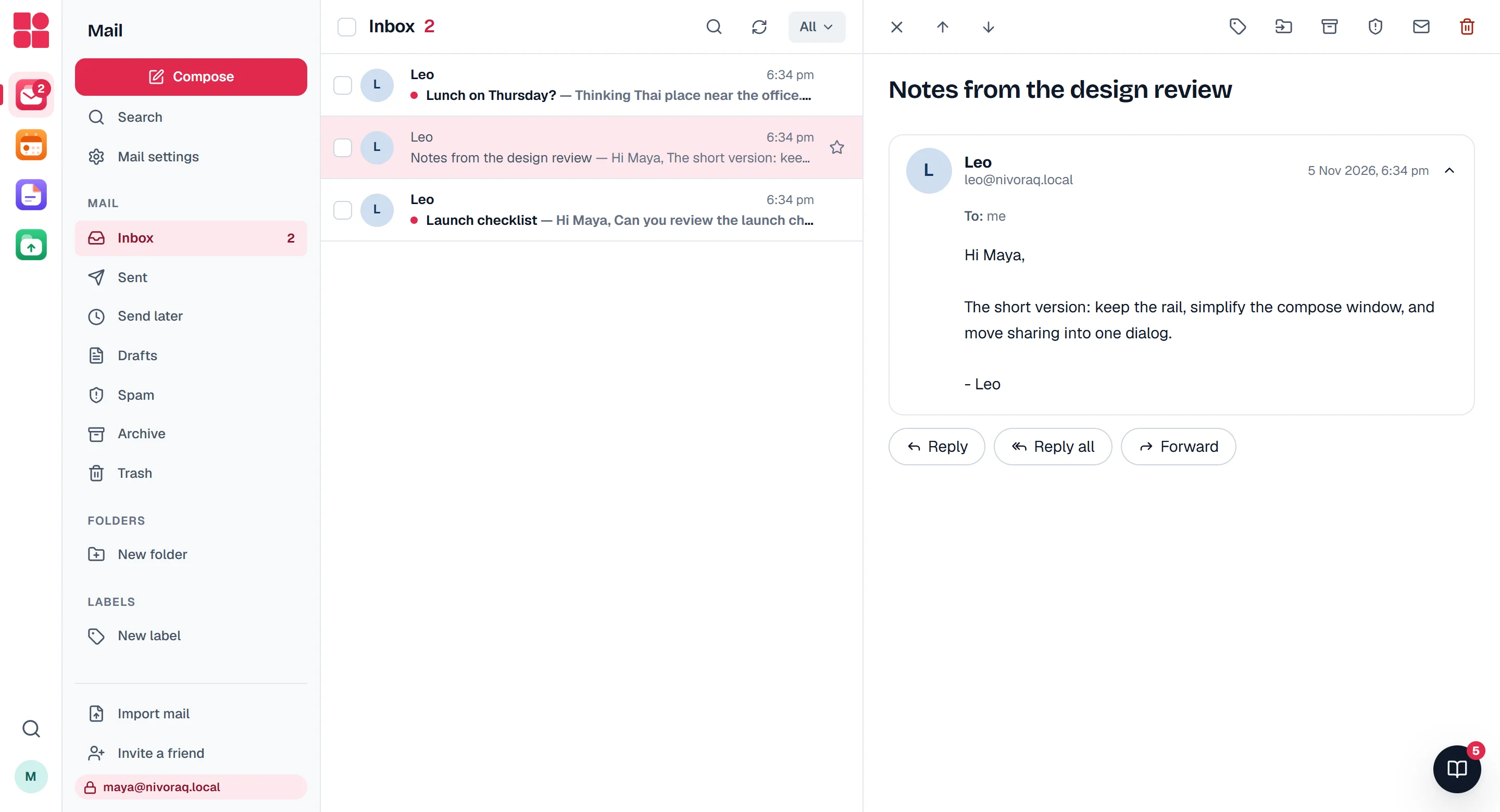
MailAn inbox, a reading pane, and a focused compose flow make space for the message itself.
DriveFolders, previews, and clear sharing permissions connect files to the people using them.
CalendarA shared view of time brings planning, focus, and collaboration into the same ecosystem.
Designing an ecosystem means thinking about what people carry from one product to the next.
The product rail gives each tool a recognizable place. Sharing exposes the difference between viewing, commenting, and editing. In Pages, feedback lives beside its context; in Mail, reading and writing have their own focus.
The screens above are the current local build, with a small sample workspace standing in for anyone’s real mail, events or files.
On mobile, the inbox and conversation become focused views. The product family stays recognizable, with the same icons and a compact navigation rail.
Original mobile Mail design concepts. Native apps remain future work.
InboxMCHey Arun,
I’ve added our project notes to the shared page. Please review them before our next discussion.
I created Nivoraq’s logo from scratch in Figma. Blocks of work, pages and messages, a half camera, an avatar, and a work stack come together in a compact modular mark. The application mockup further down is AI-generated.
Explore the brand identity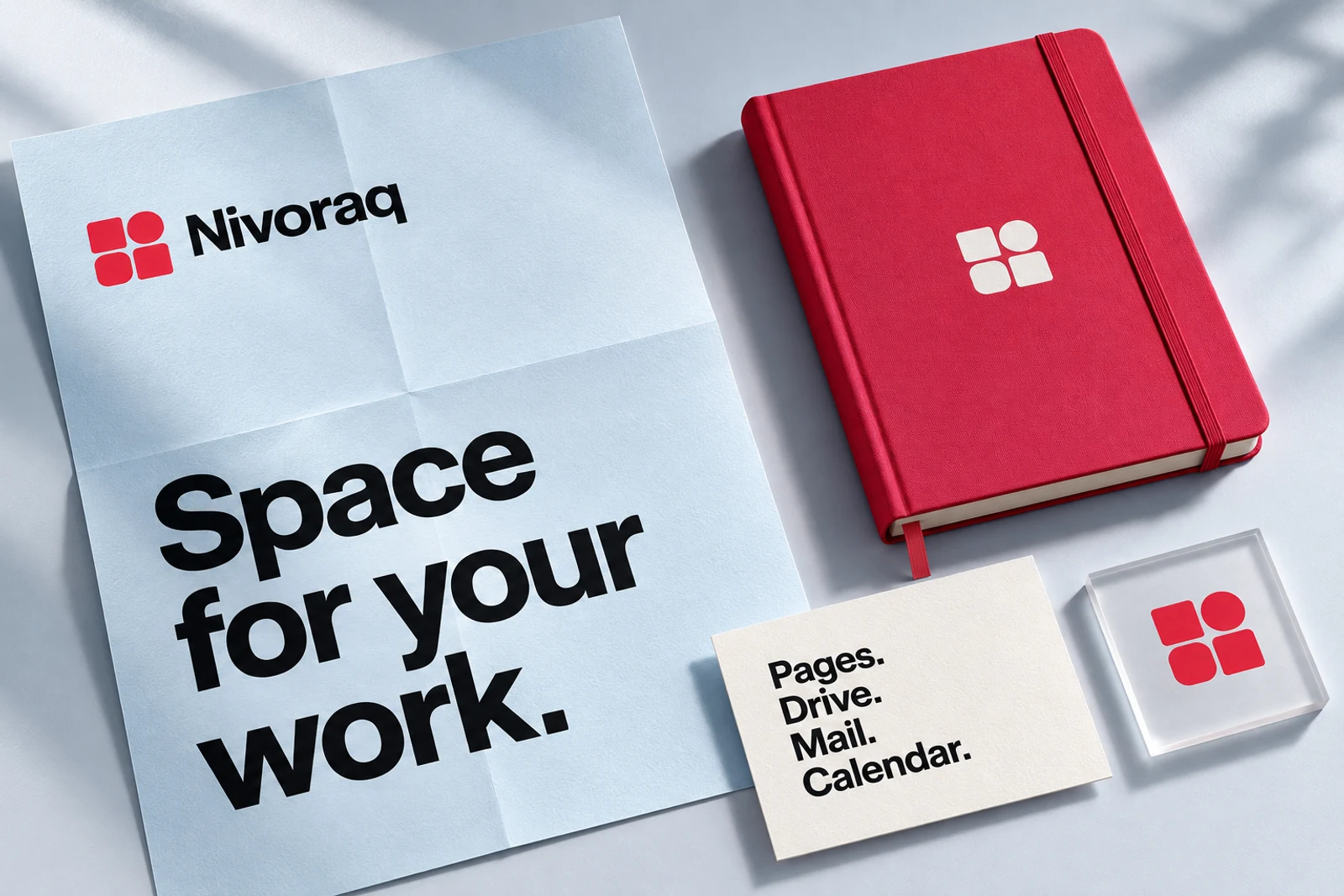
The ambition is an open-source, private workspace people can rely on.
The current local build brings Mail, Calendar, Pages, and Drive into one shell. Feature completeness varies across the products. End-to-end encryption is planned and is not implemented or audited in the inspected build.
The screens on this page come from that build with sample data. Seeing a feature here does not mean it is finished, and growth, adoption, and production security outcomes are not claimed.
Working at this scale is teaching me to move between product direction and interface detail: how the whole fits together, and what the next person needs to do.