The story
Leading the whole.
Designing the detail.
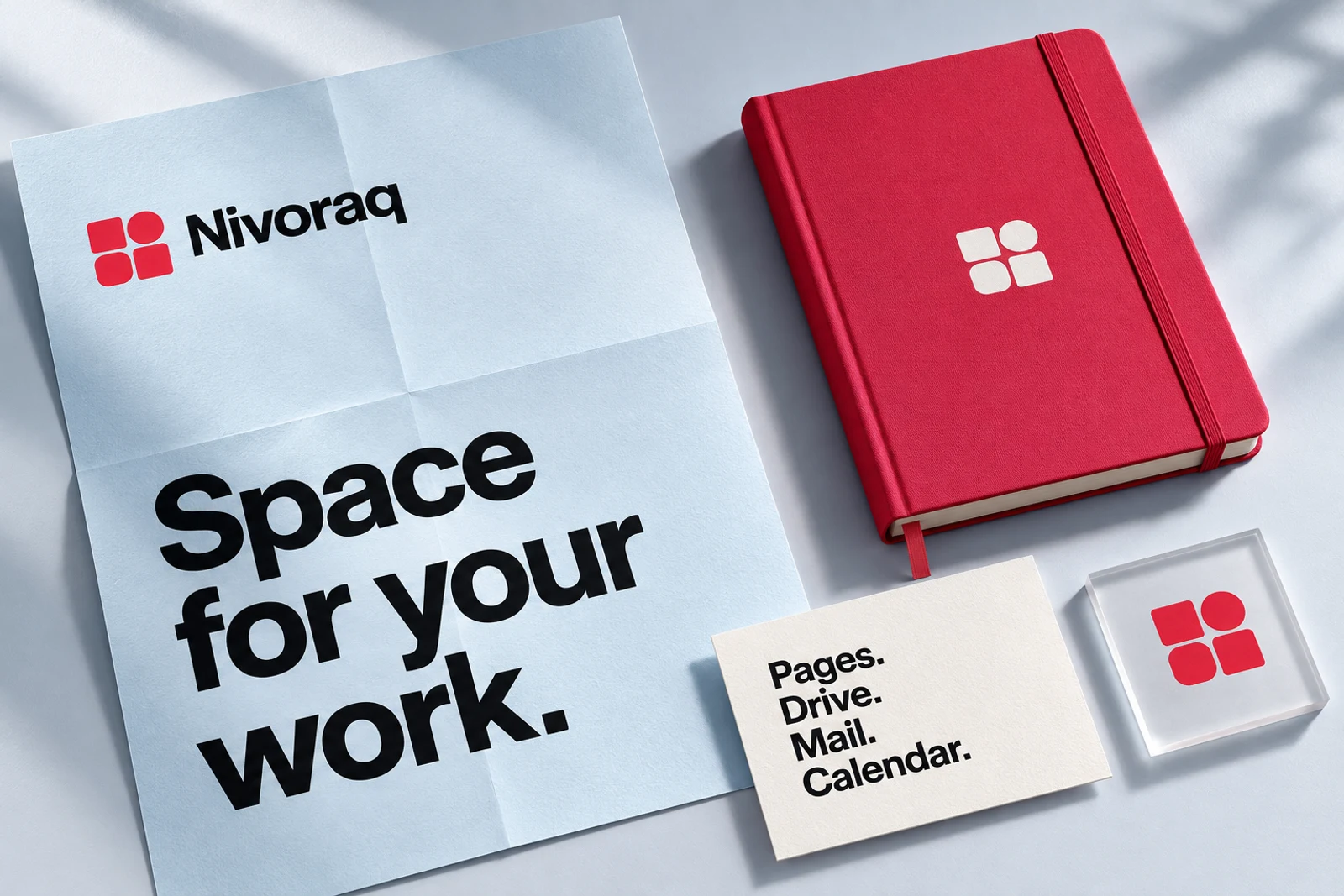
I lead Design and Product at Nivoraq, an open-source productivity company building end-to-end encrypted collaboration tools.
I’m working to scale Nivoraq from a beta product, with a focus on Pages, Drive, Mail, and Calendar. Managing that scope has helped me understand the entire product ecosystem while still making the most granular design decisions.
Nivoraq is inspired by Skiff, which joined Notion in February 2024 (opens in a new tab). That starting point informs the product scope; Nivoraq has its own identity, interface language, and product direction.
Decisions across the system
Consistency is in
the small things.
Designing an ecosystem means thinking about what people carry from one product to the next.
The product rail gives each tool a recognizable place. Sharing exposes the difference between viewing, commenting, and editing. In Pages, feedback lives beside its context; in Mail, reading and writing have their own focus.
The examples above explore app switching, document formatting, comments, tables, composing messages, file organization, and sharing permissions with original content.
Where the work stands
Building the ecosystem,
one useful step at a time.
The ambition is an open-source, private workspace people can rely on.
The current local build brings Mail, Calendar, Pages, and Drive into one shell. Feature completeness varies across the products. End-to-end encryption is planned and is not implemented or audited in the inspected build.
The interfaces on this page are portfolio design concepts, not proof that every depicted feature has shipped. Growth, adoption, and production security outcomes are not claimed.
Working at this scale is teaching me to move between product direction and interface detail: how the whole fits together, and what the next person needs to do.