Train
Small challenges for attention, memory and mental flexibility.
Memory Grid · Colour Clash · Mental Math · Go / No-Go · Symbol Shift · Odd One Out · Pattern Echo · Seen It?Cognitive Club / Product, design & build
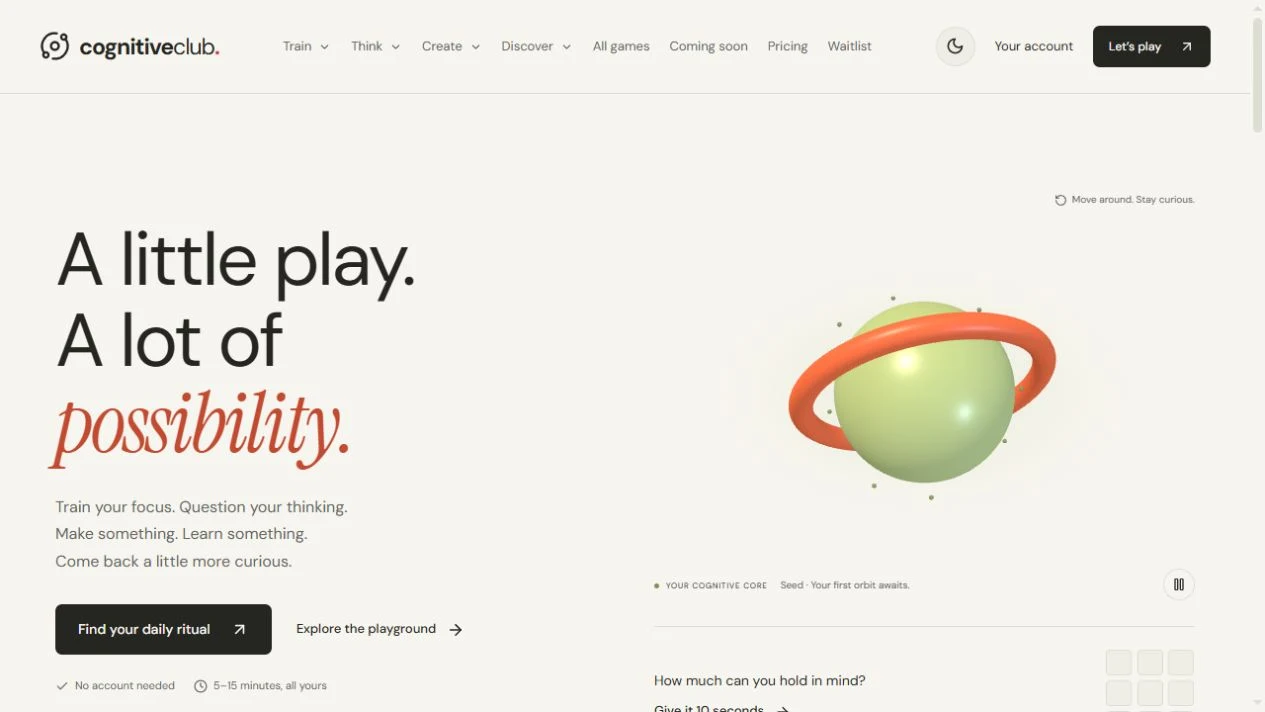
A playground for your mind. Four ways to follow your curiosity, a daily ritual to come back to, and a little world that grows with your practice.
Live site launching soon.
The idea
Cognitive Club began with a simple question: could a few minutes online feel more like play and discovery? I shaped the product around short, approachable activities rather than one score that tries to define a person.
The current build joins a searchable activity library, a fresh daily ritual, and practice history saved on the user’s own device. People can start without creating an account.
01 / Finding your next activity
Train, Think, Create and Discover describe what someone feels like doing. Search and pillar filters make a growing library easier to explore, while each card explains the activity before asking for a click.
Small challenges for attention, memory and mental flexibility.
Memory Grid · Colour Clash · Mental Math · Go / No-Go · Symbol Shift · Odd One Out · Pattern Echo · Seen It?Slow down an instinct. Find a pattern. Try another perspective.
Mini Sudoku · Next in Line · Spot the BiasA short invitation to turn a blank page into something of your own.
Writing SprintPlay with probability and see where intuition surprises you.
Chance Lab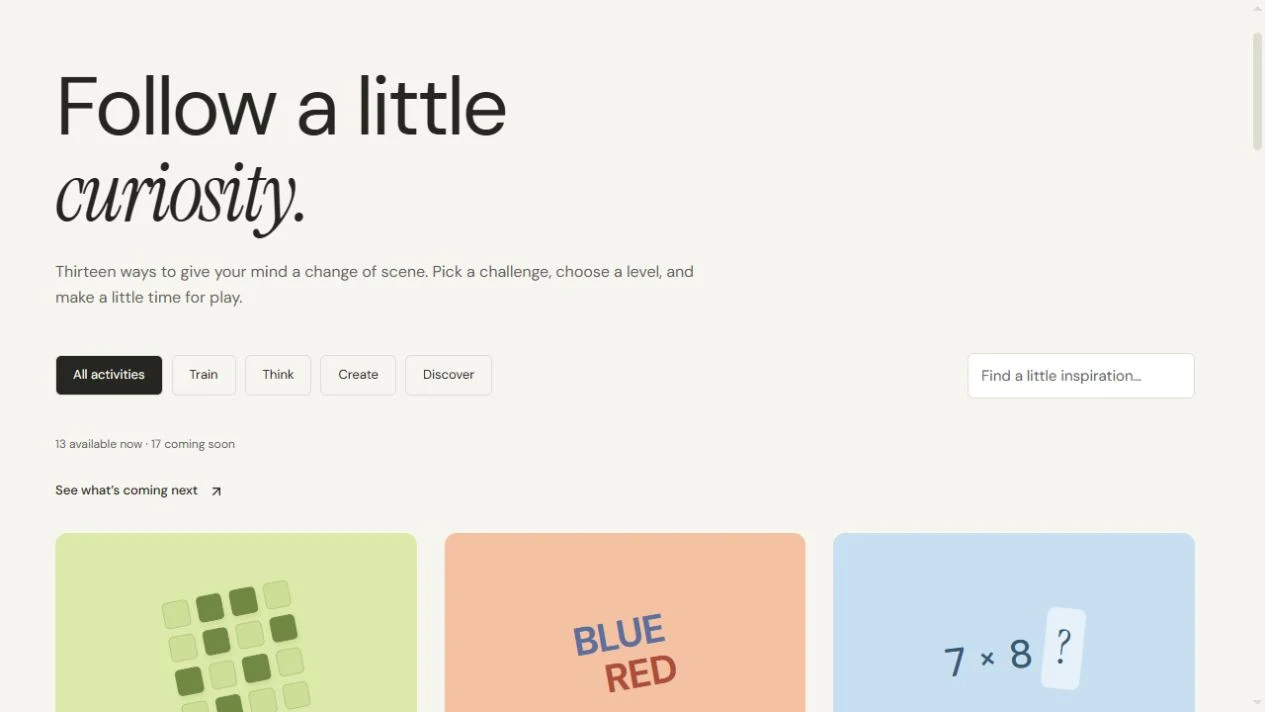
Twelve activities each have 120 generated units. Spot the Bias adds 12 original scenarios, currently presented as editorial previews. These are content counts, not usage or learning outcomes.
02 / A reason to return
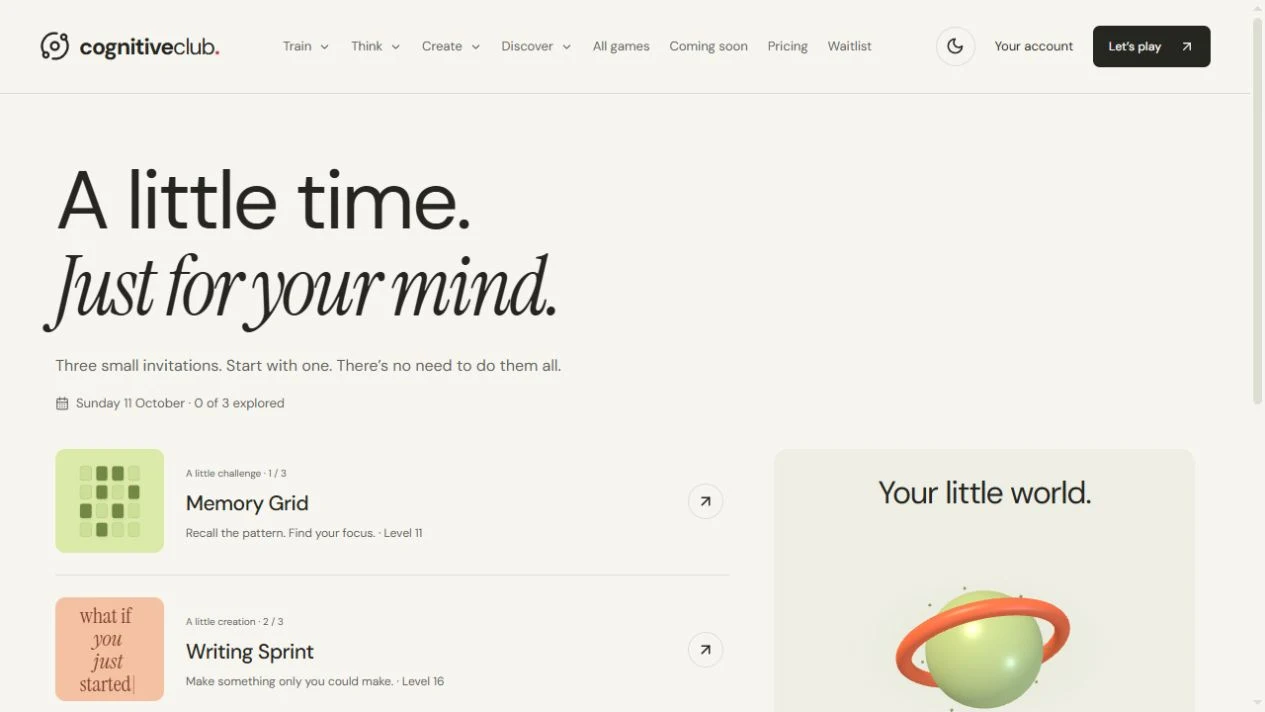
Each day offers three small invitations: a challenge, a writing prompt and a probability experiment. A deterministic daily selection keeps the ritual consistent for that date. The archive lets people return to earlier invitations instead of losing them at midnight.
03 / From browsing to doing
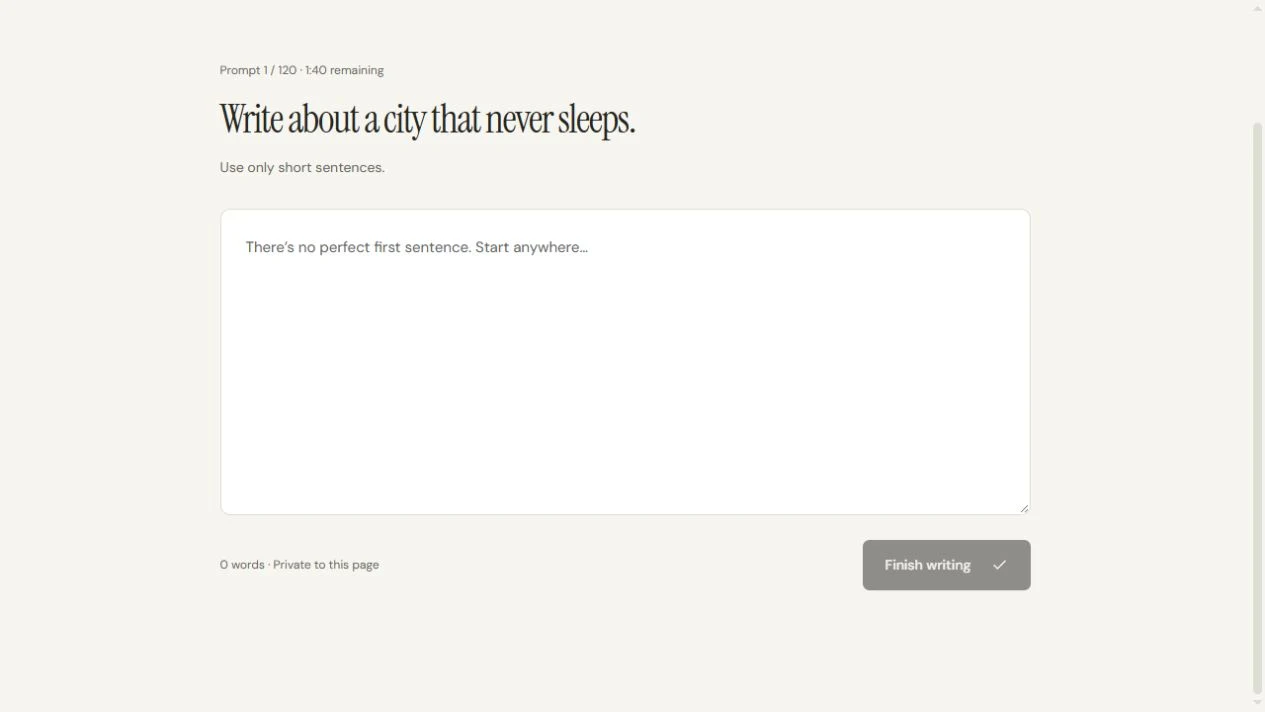
Activities explain the task, let people choose a level, and provide replay and next-level paths after a session. Writing Sprint brings a different pace: a prompt, a focused editor and time to make something. Its writing text is not stored in practice history.
04 / Progress with context
The sculptural Cognitive Core changes every eight completed sessions. It is a visual metaphor for a practice journey. The history view records real sessions and builds a task-specific baseline after three valid, comparable attempts.
Scores stay attached to their task, level, version and input method. Device-local history can be exported or cleared; it does not claim to measure intelligence or diagnose a condition.
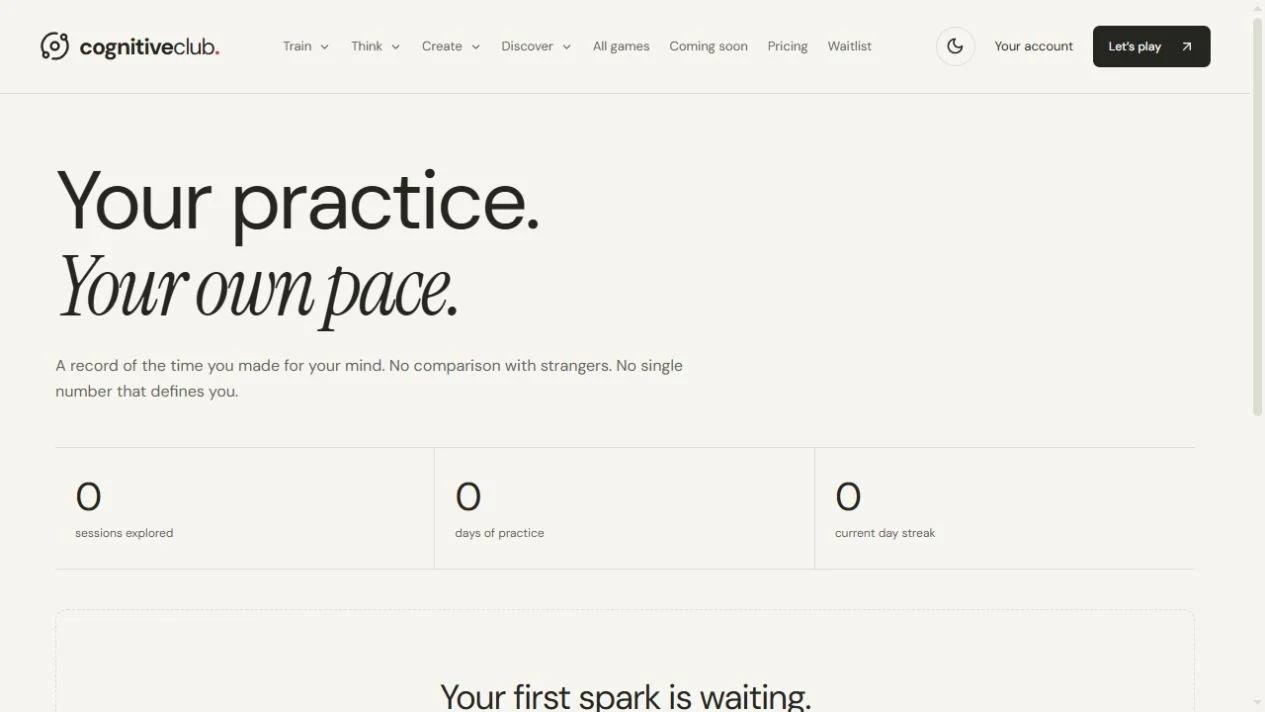
Small details, larger experience
Light and dark themes, keyboard-accessible filters, reduced-motion support and a pause control for the WebGL Core give people more control over the experience. DM Sans and Instrument Serif pair a clear interface with a warmer editorial voice.
Where it stands
The guest activity loops, daily ritual and local history are implemented in the beta. Seventeen additional activities are marked coming soon. Human matches, AI opponents, paid rewards and account synchronization are planned; they are not active features.
The next design challenge is making that broader ecosystem feel as simple as starting one small session.
Ask Modok
Ask about the work described here. Answers draw from this public page.