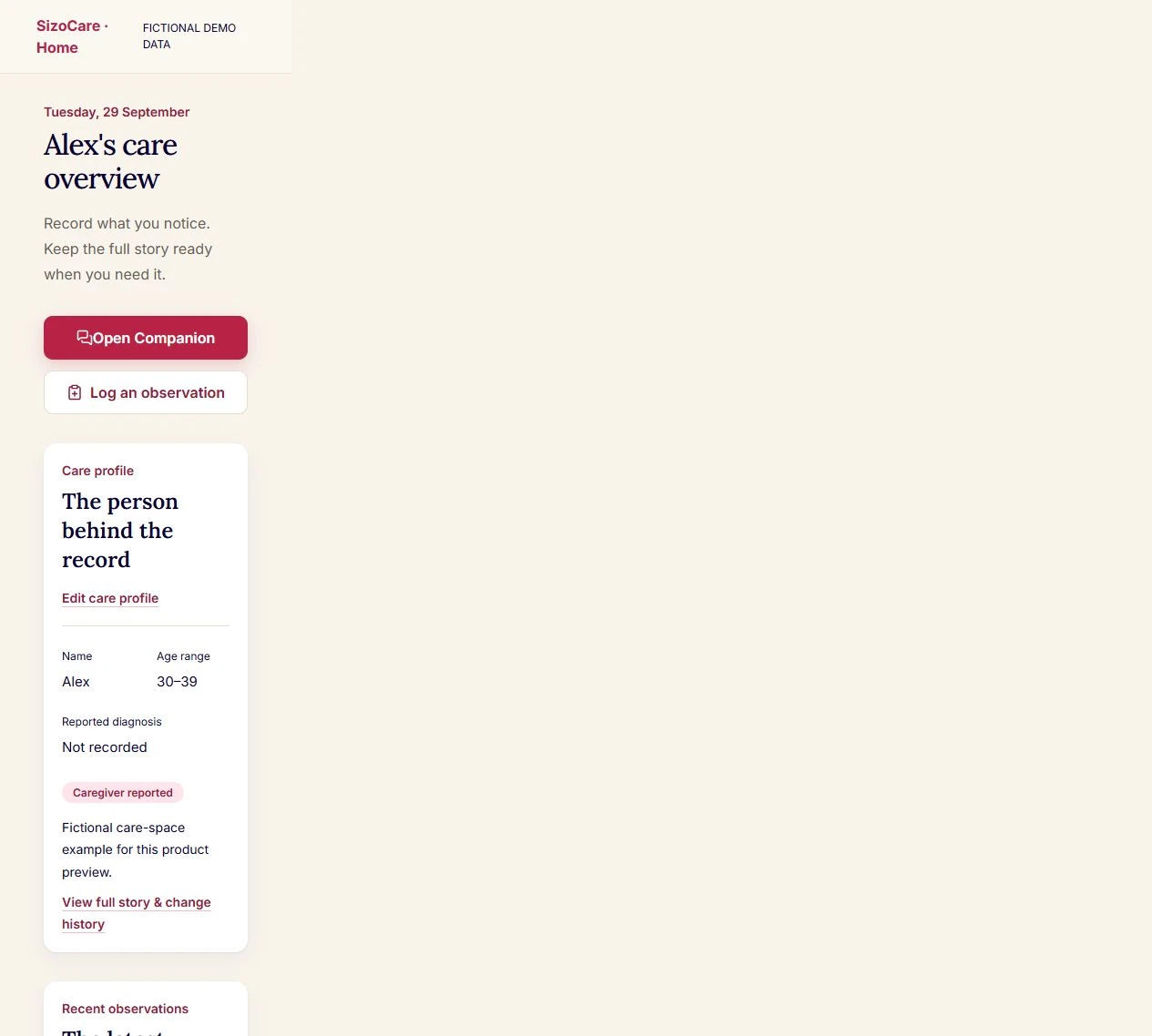
01 / At a glance
From an urgent personal need to a focused product thesis.
Caregivers improvise responses in difficult moments and reconstruct weeks of change from memory at appointments.
One reviewed case profile can connect immediate guidance, quick logs, and clearer clinician conversations.
A local product build and public website exist. Actual app captures are shown here; caregiver usability, clinical safety, and effectiveness have not been validated.
SizoCare is an idea and portfolio project being developed into a caregiver-facing product. Its requirements are draft proposals pending clinical, legal, security, and privacy review. This case study shows the product reasoning and experience design, not a measured health outcome.
The approach combines first-hand caregiver experience, journey and requirement mapping, interface prototyping, and a review of published clinical guidance. It still needs direct research with other families.
02 / Discovery
The starting evidence was one family, not a market study.
My mother has a psychiatrist-confirmed diagnosis of schizophrenia. When I began helping with her care, I had little preparation for responding patiently to frightening or fixed beliefs. Calling her psychiatrist about every conversation was unrealistic. Family changes, medication interruptions, and an approaching wedding and move added to the need for a steadier way to respond and notice change.
I mapped that experience into a caregiver journey and wrote the first requirements from it. It is a strong origin story but a low-confidence research base: other caregivers may have different routines, relationships, literacy needs, and views on what feels supportive.
When something worrying happens, help me respond calmly now and remember enough to discuss it accurately with her doctor later.
The day-to-day caregiver
Often balancing care with work and family. Needs fast, low-effort support on a phone and a private record they can trust.
The treating clinician
Receives a caregiver-approved export. Does not need an account or another dashboard to read a concise summary.
Other family members
Collaboration waits for a later version, after permissions and sharing boundaries are worked through.
03 / Problem definition
Three moments, one broken thread of information.
In the moment
A difficult conversation happens when a clinician is unavailable.
Design opportunity Offer a calm way to respond, grounded in the person's context.
Across the week
Small changes in sleep, medication, mood, and functioning get lost in memory.
Design opportunity Make observations quick to record and easy to revisit.
At the appointment
The family must compress weeks of events into a short visit.
Design opportunity Turn reviewed observations into a source-labeled clinician handoff.
help a caregiver make a thoughtful next move today and bring a trustworthy account of change to the next appointment?
The first scope choice was caregiver-only. SizoCare does not re-evaluate an established diagnosis, provide therapy to the care recipient, predict relapse, or recommend medication changes. That boundary narrows the design and leaves consent and care-recipient visibility as questions to resolve before public use.
Caregiver account, reviewed case profile, document intake, contextual chat, quick logs, symptom and medication timeline, explainable change signals, clinician summary, and crisis handoff.
Multi-caregiver collaboration, native app release, messaging and voice input, medication reminders, and condition-specific modules beyond schizophrenia.
Two earlier concepts, Caregiver Assistant and Medication Reminder + Family View, now sit inside this product direction. The Companion, observations, and medication events belong in one care journey; reminders and shared family access remain later work because consent and visibility need careful design.
04 / Experience design
A single path from context to clinical handoff.
A generic chatbot forgets the situation. A pile of logs is difficult to act on. The planned MVP makes each interaction feed the next, while requiring a person to review extracted facts and approve anything shared with a clinician.
- 01 / Establish context
Tell the story once
Start with a story, guided questions, or a document. Extracted facts wait for caregiver review before they inform the Companion.
The profile is a reviewed source of context, not a static intake form. - 02 / Find words
Ask the Companion
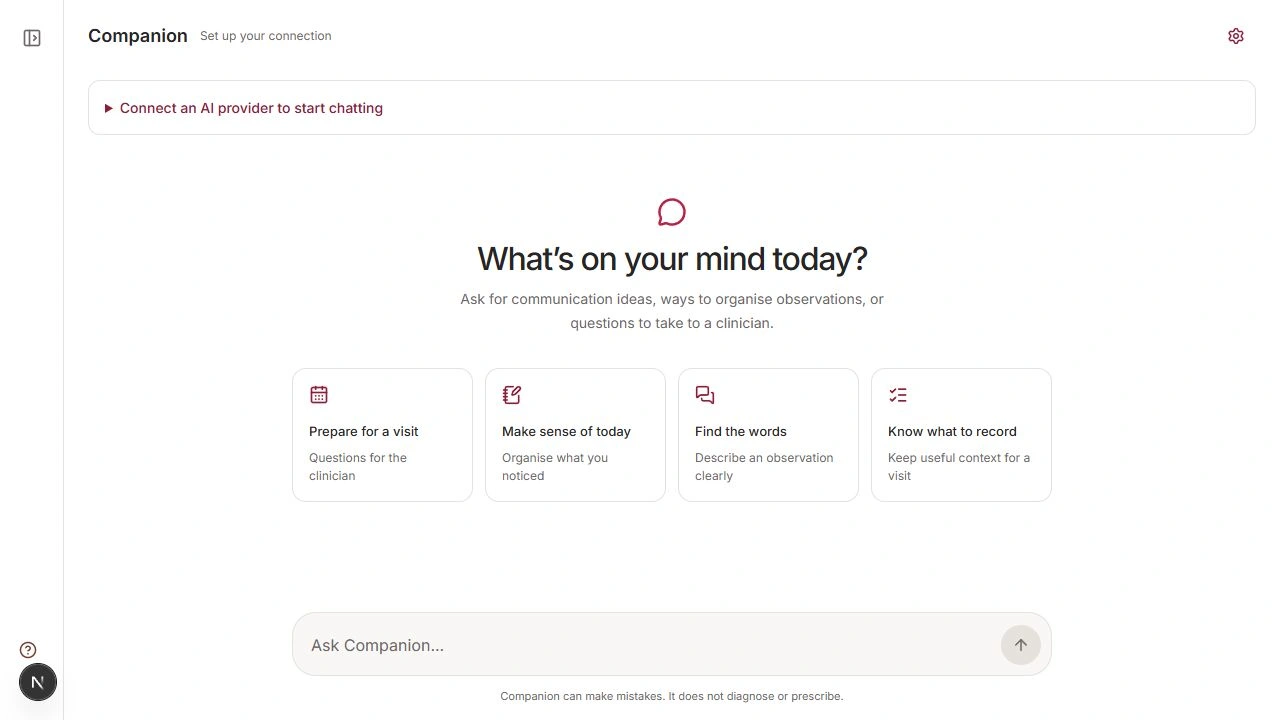
Retrieve only relevant facts and recent observations for an everyday care question. Responses should acknowledge uncertainty and keep treatment decisions with clinicians.
Help the caregiver decide what to say or record next. - 03 / Capture change
Log the small moments
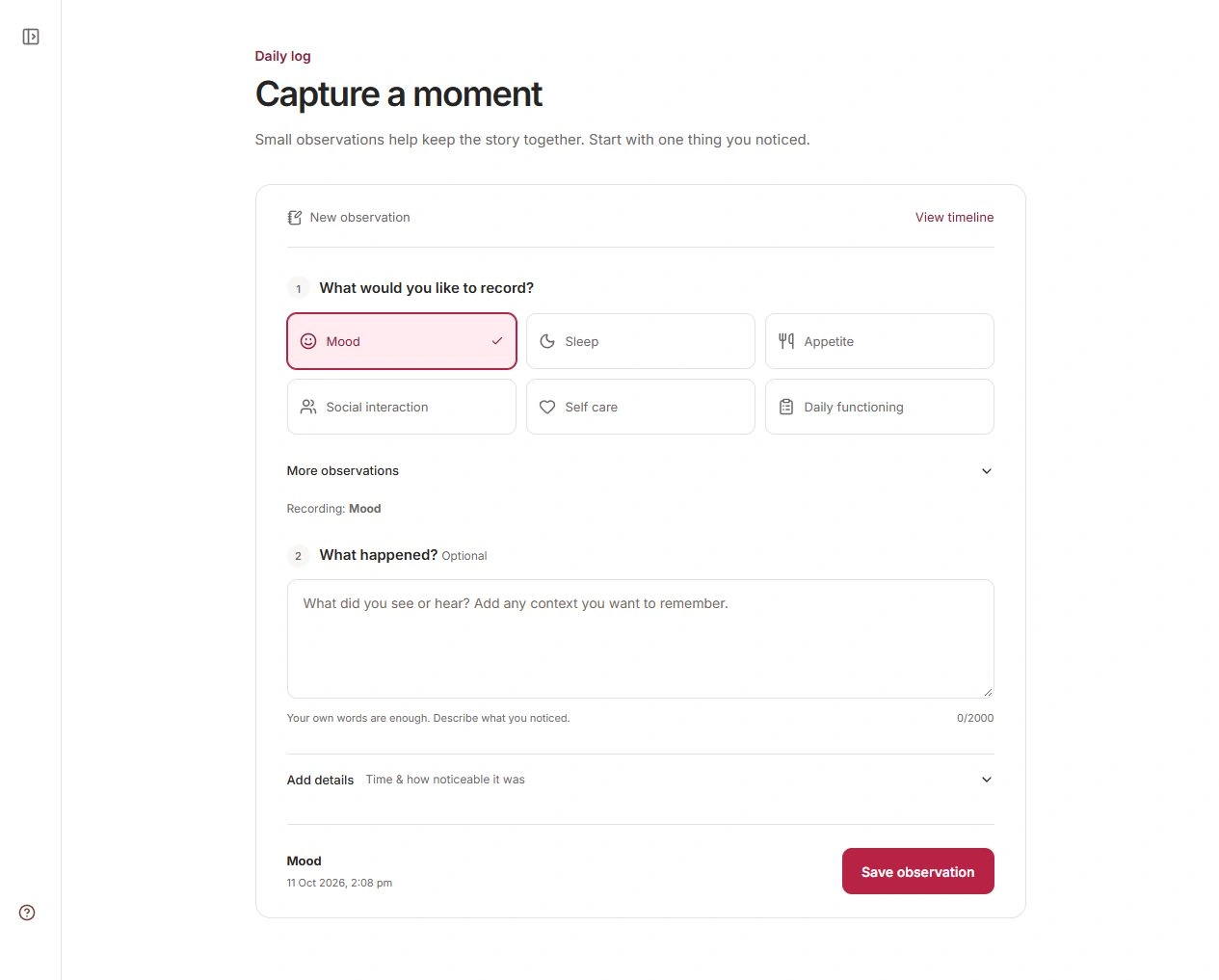
Brief entries capture sleep, mood, functioning, reported experiences, and medication taken, missed, or refused. A timeline makes the pattern visible.
Mobile-first entry reduces the effort of recording something as it happens. - 04 / Review a signal
Compare with her baseline
A proposed rules-based signal compares recent entries with the same person's history, naming the period and supporting observations. Sparse data produces no signal.
Explain what changed instead of showing a clinical-looking risk score. - 05 / Prepare the handoff
Bring a better summary
Review an editable draft of key changes, medication events, and questions. The export separates observed or reported facts from AI organization.
The clinician gets a concise account; the caregiver controls what is shared.
Current product screens
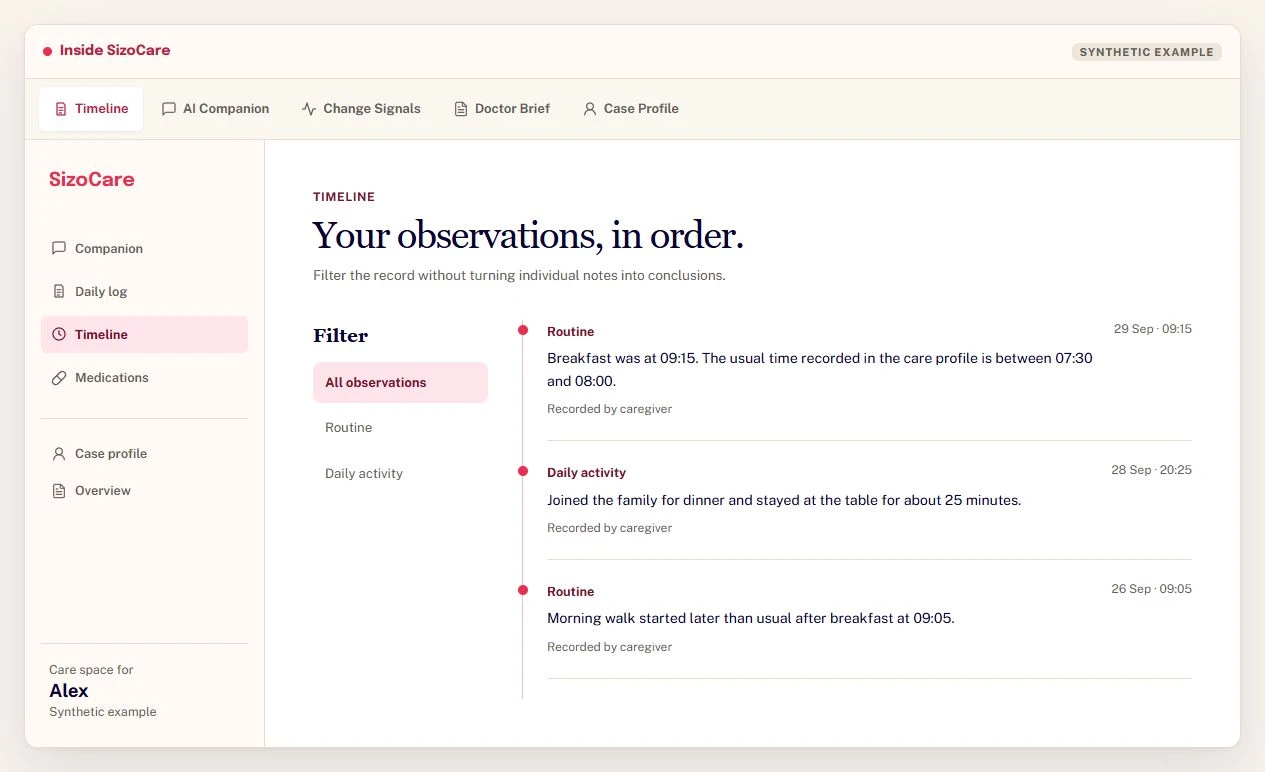
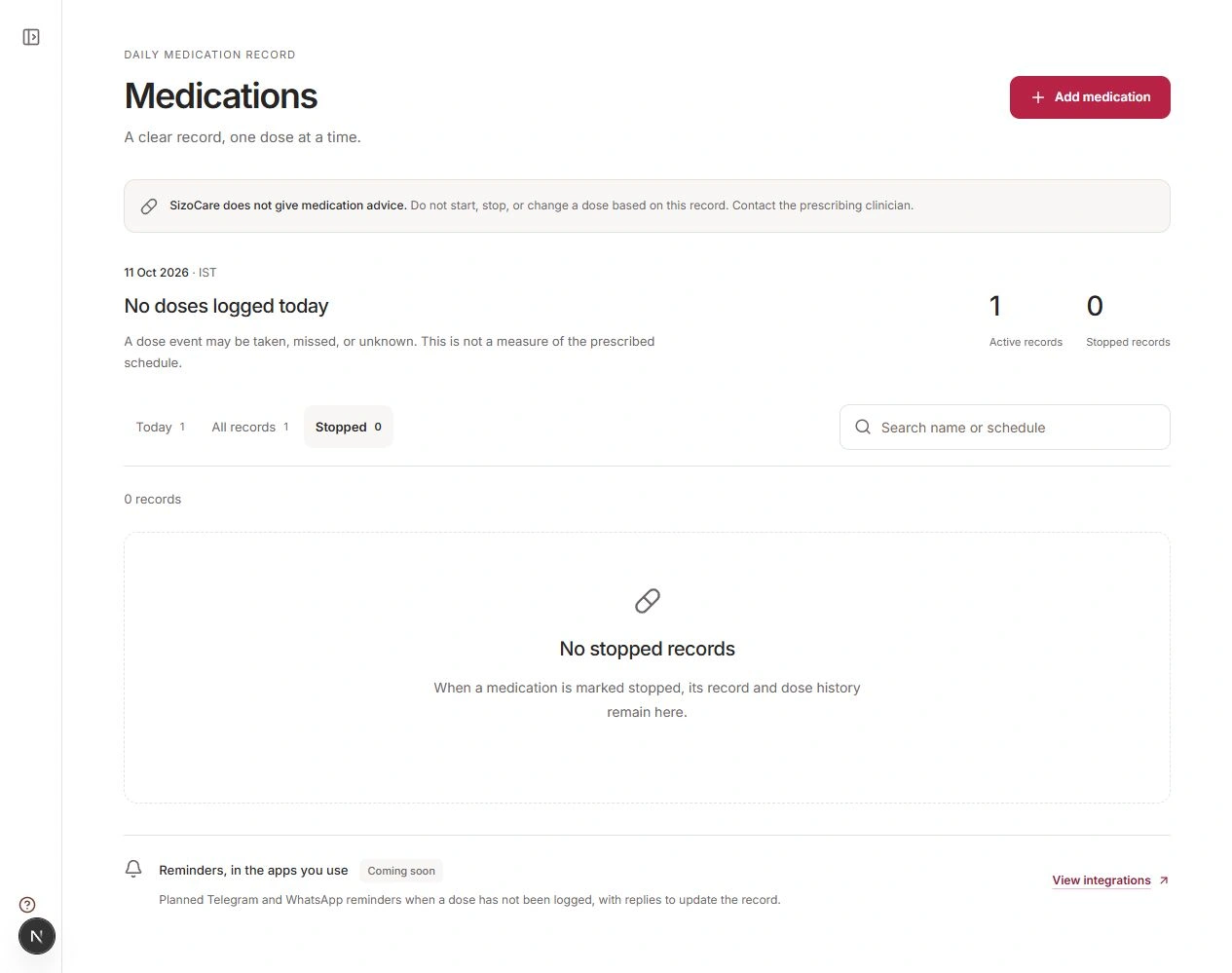
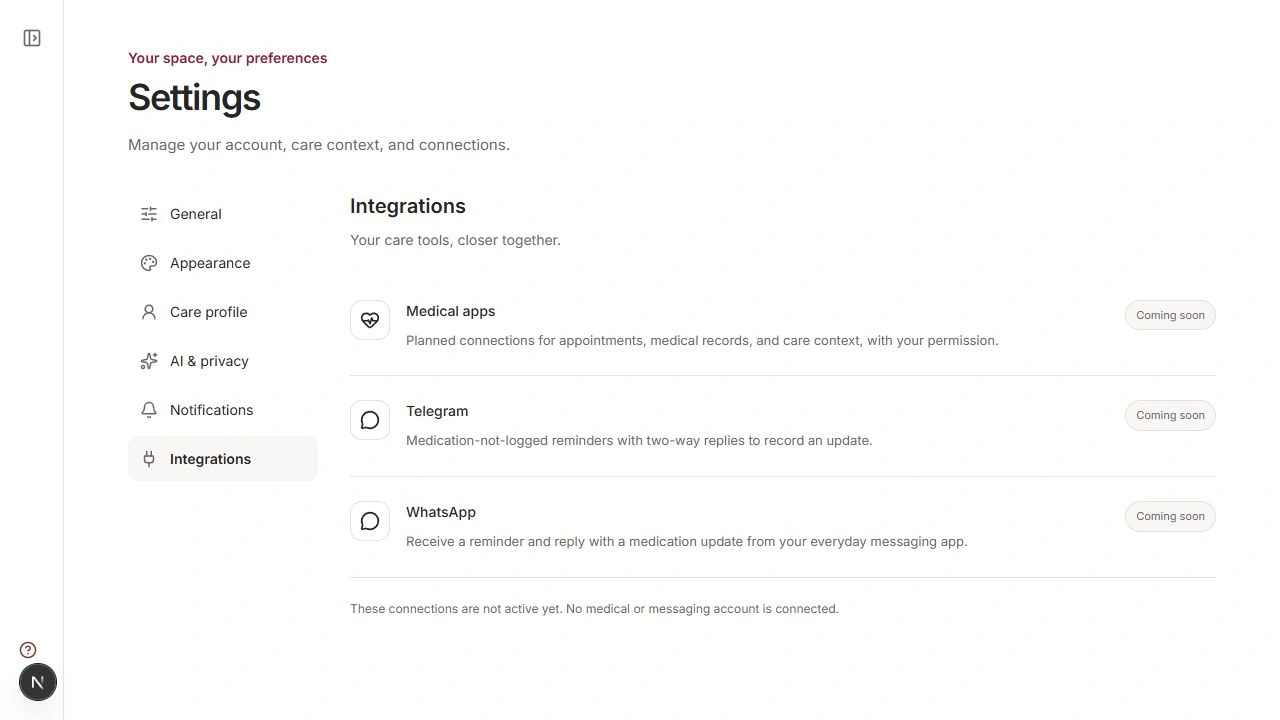
Captured directly from the signed-in local app: Companion, daily observations, medication records and integration settings. Empty states and an unsubmitted form show the implemented interfaces without publishing personal care records. Companion requires an AI provider connection, and integrations are explicitly coming soon. These captures do not establish production availability or clinical validation.
A populated timeline
A high-stakes branch changes the interface
If a chat message or log suggests immediate danger, crisis resources must lead the screen before ordinary AI content. The product cannot certify that someone is safe; it should route the caregiver to the treating team or local emergency support.
05 / Design decisions
Why the experience is shaped this way.
Caregiver-only MVP
The primary unmet need belongs to the person supporting care day to day. One account keeps the first journey focused.
Tradeoff Care-recipient consent and visibility remain open; shared family access comes later.
Review facts before reuse
Documents and AI can organize information but can also misread it. Source tags and a review state make uncertainty visible.
Tradeoff Onboarding takes longer before chat can use the profile.
Personal baseline, no risk score
A change in one person's sleep or functioning is more meaningful against their own history than a generic norm.
Tradeoff Signals need enough logging history and stay silent when evidence is thin.
Human handoff for safety
The product can surface crisis resources and organize observations, but cannot assess safety or prescribe treatment.
Tradeoff An urgent handoff interrupts chat; conservative detection may raise false alarms.
A previous attempt to give medication covertly damaged trust in the source situation. The planned Companion must discourage covert medication, avoid affirming unverified beliefs as fact, and defer diagnosis and treatment choices to clinicians. These are release-blocking design requirements, not clinically proven features.
06 / Validation plan
What would make this more than a convincing prototype?
Artifacts in hand
- Founder-origin caregiver journey and problem framing.
- Local authenticated product implementation and current public website.
- Four actual signed-in local product captures, plus the fictional home and timeline examples.
- Draft PRD, architecture, data/API contracts, and MVP sequence.
Proof still needed
- Usability sessions with caregivers outside the founding family.
- Clinical review of guidance, crisis escalation, and summary wording.
- Legal and privacy decisions about care-recipient consent and AI data use.
- Evidence that regular logging and change signals help without causing alarm.
Draft beta measures, not results
Draft hypothesis for usable change detection
Draft beta target: useful rather than alarming
Draft beta target within 48 hours
The proposed rollout starts with internal use and an invite-only caregiver beta. No adoption, retention, safety, or clinical efficacy result is claimed. A confirmed unsafe Companion output would block release and require the feature to be disabled and reviewed.
Research and clinical guidance used for the framing
07 / Reflection
The design is only useful if it strengthens human care.
The strongest product insight was to connect three needs often treated separately: finding words in the moment, remembering change, and explaining it to a clinician. The hardest unresolved design question is whose story the profile is and how the person receiving care can have agency over it.
SizoCare starts with schizophrenia because that is the lived experience behind the concept. Bipolar disorder, autism, and other care contexts are future possibilities, each requiring separate research, language, safeguards, and specialist review rather than a generic condition switch.
Talk about SizoCare