 SigBlaze Evidence to action
Product design / Product strategy / AI workflow
Market research with source review
An AI-assisted market intelligence workspace connecting research, stored evidence, reviewed insights, monitoring and creative direction.
- Project status
- Working local prototype · private-alpha positioning
- Documented build
- V2 · September–October 2026 source snapshot
- Case study
- Akhil Ram / Cosanyasi
10 minute read · design and technical perspective

The product
The product
SigBlaze connects market research to the decisions it is meant to inform. An agency strategist or product marketer can define a question, collect sources, inspect claims, review insights, and turn approved intelligence into positioning, campaign direction, battlecards or reports. Monitoring brings later changes back into the same workspace.
The delivered artifact is a working local application and a product website, supported by a V2 product definition, architecture, data model and software tests. The screens here come from its fictional demo workspace. They demonstrate the interaction model; they do not establish customer adoption or the accuracy of live market research.
The problem
Research loses its sources and context as it moves into strategy and creative work.
The product response
Keep one inspectable chain from source to claim, insight, review and action.
The design scope
Product framing, research/review flows, uncertainty states and AI workflow boundaries. Individual ownership and team credits remain to be confirmed.
The demonstrated outcome
A working local product, authentic demo screens and tested service contracts. Business and usability impact remain unvalidated.
Origins and reframing
From LIT to SigBlaze
SigBlaze began as the LIT research project: an industry research → insights → insight-led creative workflow for the LIT School × AI Learn Circle GTM hackathon. The first experiment joined research, evidence, synthesis and creative hooks in one loop. It became the starting point for SigBlaze rather than a separate portfolio project. Precise hackathon dates, team credits and submission outcomes remain unconfirmed.
The later V2 scope reframes that challenge as reusable evidence-to-action intelligence for agencies and B2B teams. Instead of stopping at a polished ad idea, the system needs to explain what the idea rests on and preserve that reasoning for the next question. September’s V2 definition and October’s monitoring implementation describe this evolution, not a verified end-to-end project timeline.
Problem framing
Research across disconnected tools
The PRD identifies fragmented research across browser tabs, AI conversations, review sites, spreadsheets and documents. Its central hypothesis is that teams repeatedly rediscover information, lose attribution and miss changes. This is a documented product hypothesis, not a finding from interviews conducted for this case.
A reviewer needs to inspect the sources behind claims, insights, and recommendations. They also need access to contradictory reviews and a clear explanation when the system lacks evidence for an answer.
The fragmented workflow
Research → collect tabs → summarise → copy into a brief → lose context → start again.
The intended continuity
Define a goal → persist sources and claims → inspect disagreement → review an insight → create an action → revisit the evidence.
Who it serves
Intended users
The initial audience in the product definition is boutique B2B agencies, fractional CMOs and GTM consultants, and SaaS founders or product marketers doing recurring competitor research. These are intended audiences, rather than personas validated by participant studies.
For an agency strategist, the job is: when I prepare a client recommendation, help me connect it to inspectable sources so I can explain and revise it. For a product marketer: when a competitor changes pricing or positioning, help me understand the difference and decide whether our battlecard needs updating. Workspace separation, freshness, contradiction visibility and review history support these jobs.
Product strategy
MVP scope
The prioritisation document makes the first vertical slice explicit: workspace → research goal → plan → sources → claims → contradictions → insights → action → review/export. This gives each screen a reason to exist and keeps creative generation downstream of the evidence.
Monitoring and briefs were initially later-stage scope. The current source and interface now include them, along with a graph and automations. They remain part of one integrated evidence system. Email alerts, uploaded-document retrieval and richer exports should not be inferred from the presence of a roadmap or marketing page.
A useful MVP hypothesis is that a target user can inspect the evidence behind a recommendation and reuse it for a second decision. The next validation should measure that task, source trust and review effort. No measured time saving or conversion improvement is available.
- SourceOriginal material, dates and passages
- ClaimOne inspectable factual proposition
- EvidenceSupports, contradicts or contextualises
- InsightInterpretation with confidence and freshness
- ReviewA person approves or rejects
- ActionA draft retaining its source trail
Explanatory map of the implementation. Monitoring feeds changes into this evidence system; a model is not the final reviewer.
Adjacent alternatives
Where this product needs to earn its place.
Current desk research helps situate the product. These tools already solve important parts of the job; the opportunity below is a product hypothesis, not a claim that SigBlaze outperforms them.
| Alternative | Documented focus | Implication for SigBlaze |
|---|---|---|
| Perplexity official documentation, opens in a new tab | Cited search, synthesis and follow-up questions. | Citations are an established expectation. Focus on persistent review and downstream action lineage. |
| Similarweb official documentation, opens in a new tab | Digital audience, traffic and competitive research. | SigBlaze is not a substitute for a proprietary traffic dataset; it organises retrieved evidence. |
| Semrush official documentation, opens in a new tab | Competitor web activity monitoring alongside market tools. | Monitoring alone is not unique. Connect a detected change to an inspectable, reviewed decision. |
From concept to system
The design process is visible in the boundaries.
The available artifacts show a legacy campaign-oriented concept, a broader V2 product definition, domain and provider contracts, staged services, and a working interface. They support a progression from output generation toward persistent intelligence. Original wireframes, workshop notes and dated design iterations were not available.
I reconstructed the flows and decision comparisons from the implementation I inspected. I drew the diagrams for this case study; they are not historical research artifacts. I used them to examine what a reviewer can inspect and approve at each stage.
Information architecture
Several ways in. One body of intelligence.
The app separates the work a person does, the records that work produces, and workspace configuration. Ask is the entry point; research and monitoring build evidence; reviewed intelligence moves into actions. The graph exposes relationships across these surfaces.
Work surfaces
- Ask
- Research
- Signals
- Monitor
- Briefs
- Insights
- Actions
- Automations
Intelligence records
- Graph
- Subjects / competitors
- Sources
- Claims inside runs and insights
- Saved questions and history
Workspace configuration
- Company / product context
- Workspace and invitations
- Provider connections
- Personal preferences
- Search and commands
The core journey
Follow the evidence through the interface.
A fictional analytics team researches competitors, inspects a disputed onboarding promise and reviews a pricing change. Each stage below shows a captured screen, the user’s objective, the system’s job and a recovery path.
1 / 6 · Bound the question before generating an answer.
Frame the question
Compare competitors for a specific buyer and market.
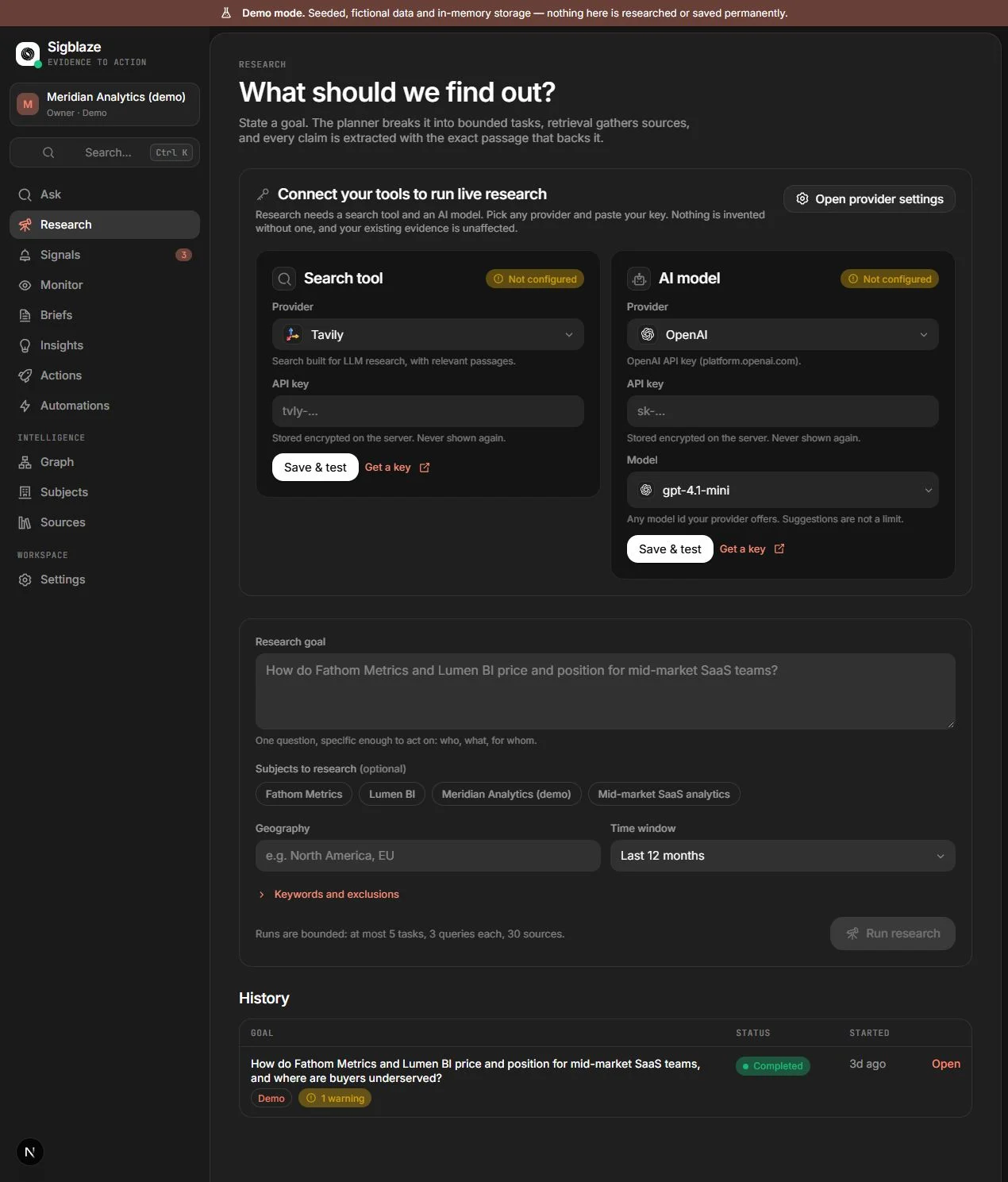
- Behind the interaction
- Pin the workspace context; plan tasks and retrieval queries.
- When it needs attention
- Connect providers before running; narrow the scope if the question is too broad.
Decisions and tradeoffs
The product is defined by what it refuses to skip.
These comparisons reconstruct the rationale of the inspected build. They are not a substitute for an original dated decision log.
A workspace that remembers
ProblemRepeated research loses company context and the evidence behind previous answers.
AlternativeA new chat or report for every question.
DecisionVersion company, product, ICP and market context, and pin it to each run.
RationaleA reviewer can understand which assumptions shaped the result.
TradeoffOnboarding takes effort, and stale context needs maintenance.
Observed implementationContext snapshots and reusable sources exist in the implementation.
Claims before conclusions
ProblemReviewers need to check the sources behind individual statements in a summary.
AlternativeSummarise retrieved text directly into recommendations.
DecisionExtract atomic claims and retain supporting passages before synthesising insights.
RationaleSmall factual propositions are easier to inspect and reuse.
TradeoffMore entities and relationships make the interface and storage more complex.
Observed implementationClaims, source observations and typed evidence links are persistent entities.
Disagreement stays visible
ProblemMarketing promises and customer accounts can conflict.
AlternativeBlend the sources into one confident sentence.
DecisionRetain supports, contradicts and contextualises relationships; label contested claims.
RationaleUncertainty belongs at the point where someone makes a decision.
TradeoffThe user must sometimes investigate rather than receive a neat answer.
Observed implementationThe captured claim view preserves both sides, with deterministic status rules.
AI proposes; a person approves
ProblemAn unsupported interpretation can become convincing campaign copy.
AlternativeGenerate the deliverable immediately from the research output.
DecisionRequire approved insights before action generation, with separate draft and review states.
RationaleThe accountability boundary is visible in both the interface and service logic.
TradeoffReview introduces a deliberate pause in the workflow.
Observed implementationThe action service rejects unapproved inputs and retains exact lineage.
Detect first, explain second
ProblemA model can describe a change that never happened.
AlternativeAsk an LLM whether a competitor changed something.
DecisionCompare stored snapshots, then optionally use a model to explain the detected difference.
RationaleChange detection can be deterministic; interpretation can remain probabilistic.
TradeoffPage extraction and noisy changes need careful handling.
Observed implementationBaseline checks, snapshot history, signal evidence and failed-check states are implemented.
Bound the work and admit failure
ProblemUnbounded research can consume time and money without a trustworthy result.
AlternativeOne large prompt, unlimited searches and a generic error.
DecisionUse staged tasks, bounded retrieval, validated references, retry/cancel and explicit insufficiency.
RationaleThe product should expose what it knows, what failed and what can recover.
TradeoffA refusal or partial result can feel less impressive than a confident answer.
Observed implementationAllowed-ID manifests, source-span checks and provider-error paths exist and have selected test coverage.
AI workflow
AI tasks and storage
The implementation is a Next.js modular monolith with API services, a store abstraction and replaceable model/retrieval adapters. Real mode uses Supabase; the observed local demo uses an in-memory store. Research pins context, plans bounded tasks, retrieves and deduplicates sources, extracts claims, checks contradictions and synthesises insights.
Model tasks have typed inputs and schema-validated outputs. An allowed-reference manifest rejects IDs the model was never given. Source-span validation checks that a quoted passage appears in the stored material. Ask reads stored evidence and has an explicit insufficient-evidence path. These checks constrain failure; they do not make every cited claim true.
Models handle planning, extraction, interpretation and drafting. Software handles ownership, source deduplication, reference validation, claim-status policy, snapshot comparison, review gates and exports. This division is more useful here than claiming an autonomous agent swarm. Adapters for Gemini, Anthropic and OpenAI-compatible models exist; configured live provider success was not established in this review.
Research stages record state and support retry/cancel. The inspected start-run path executes the service rather than proving an independently deployed job queue. Scheduling likewise needs an external cron trigger and deployment secrets. Provider absence and partial retrieval are product states, not successes to simulate.
Inputs
Workspace + research goal
Versioned context, subjects, geography, time window and exclusions.
↓ Bounded plan and retrieval
Next.js services + typed model tasks
Retrieve → extract → validate → synthesise
Normalise sources and spans. Validate schemas and allowed references. Persist claims, conflicts and insights.
↓ Human review → action draft
Shared store
One evidence graph
Supabase in real mode; in-memory demo observed. Ask and briefs reuse stored intelligence.
Snapshots → differences → signals
Implementation map, reconstructed from services and task contracts. Production provider, database and scheduling operation are separate validation steps.
The wider system
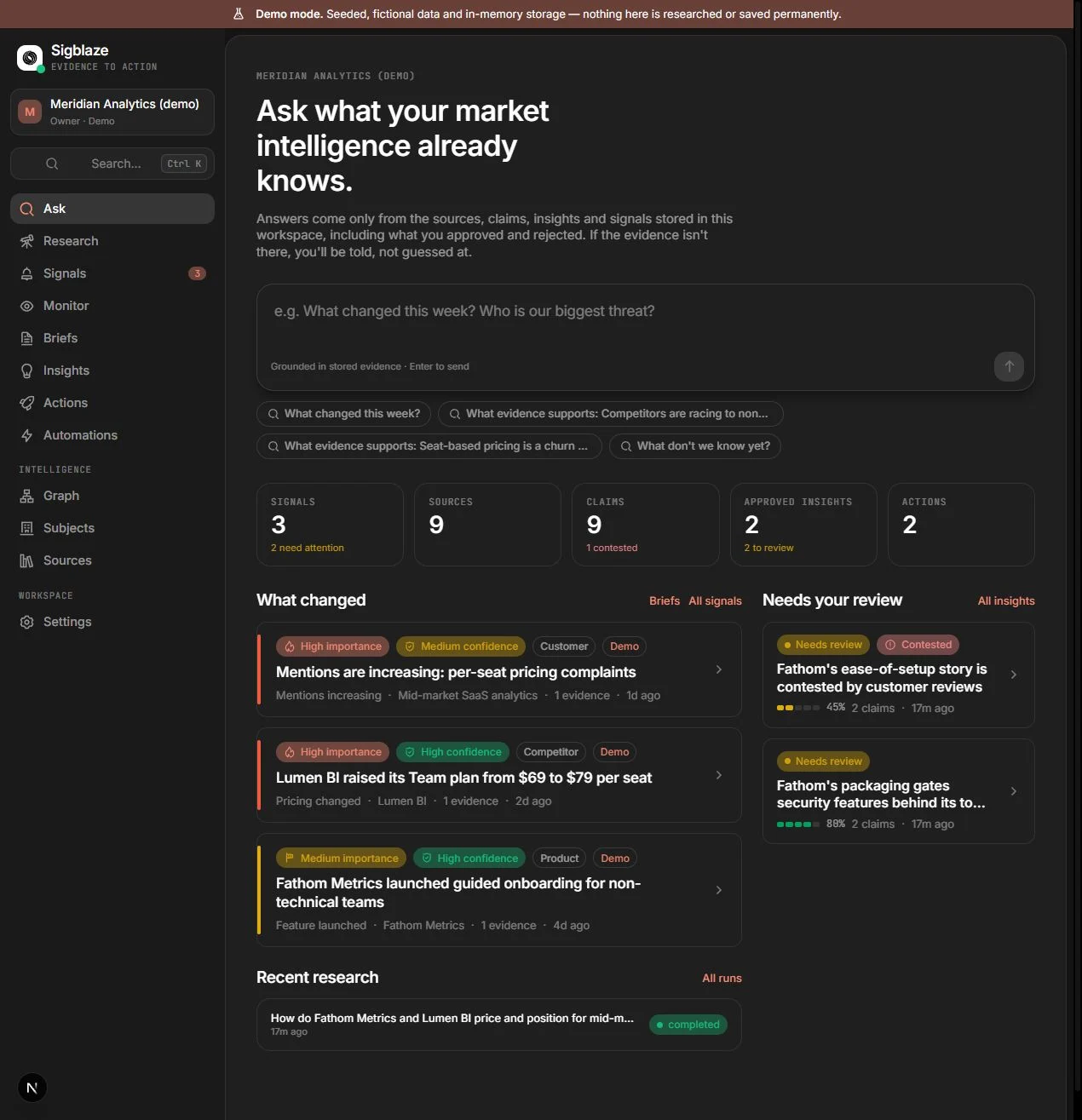
Keep watching. Keep the context.
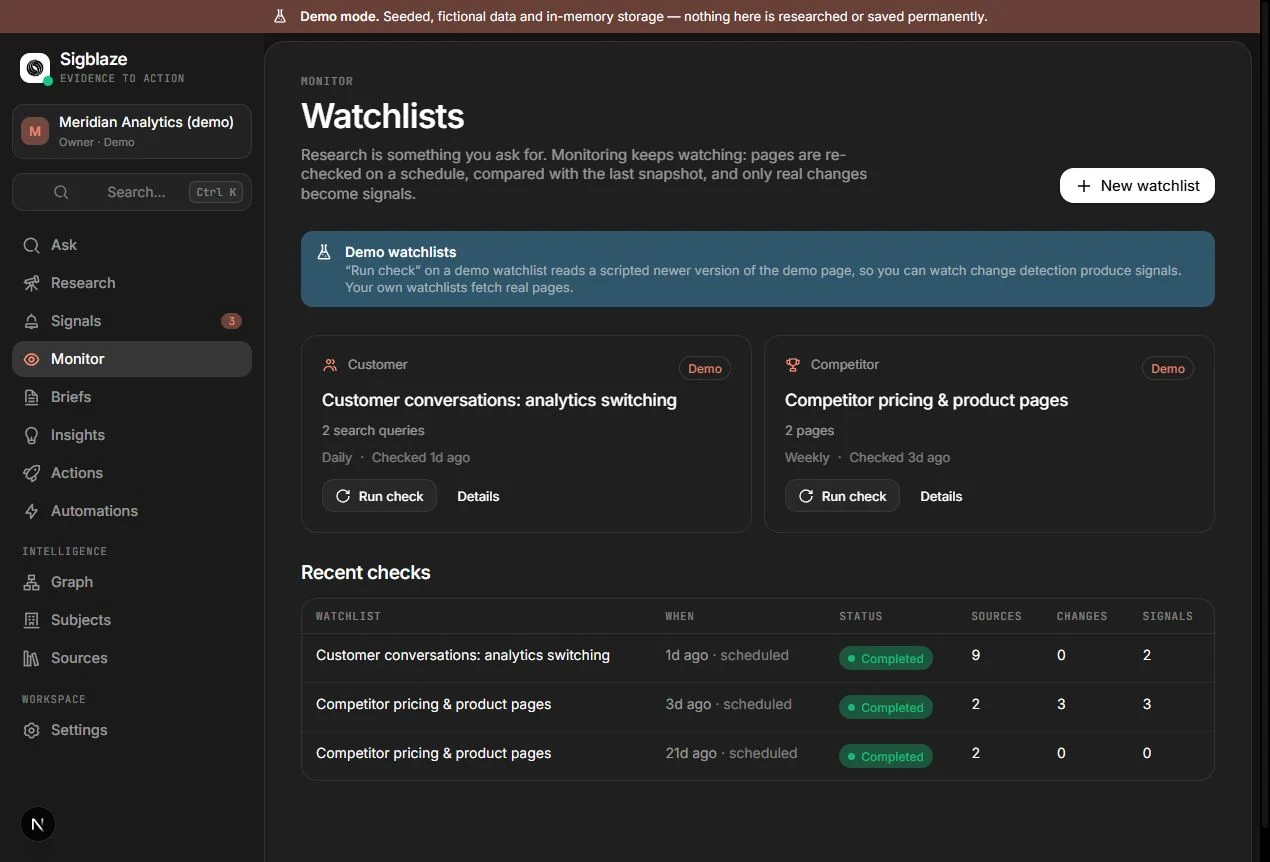
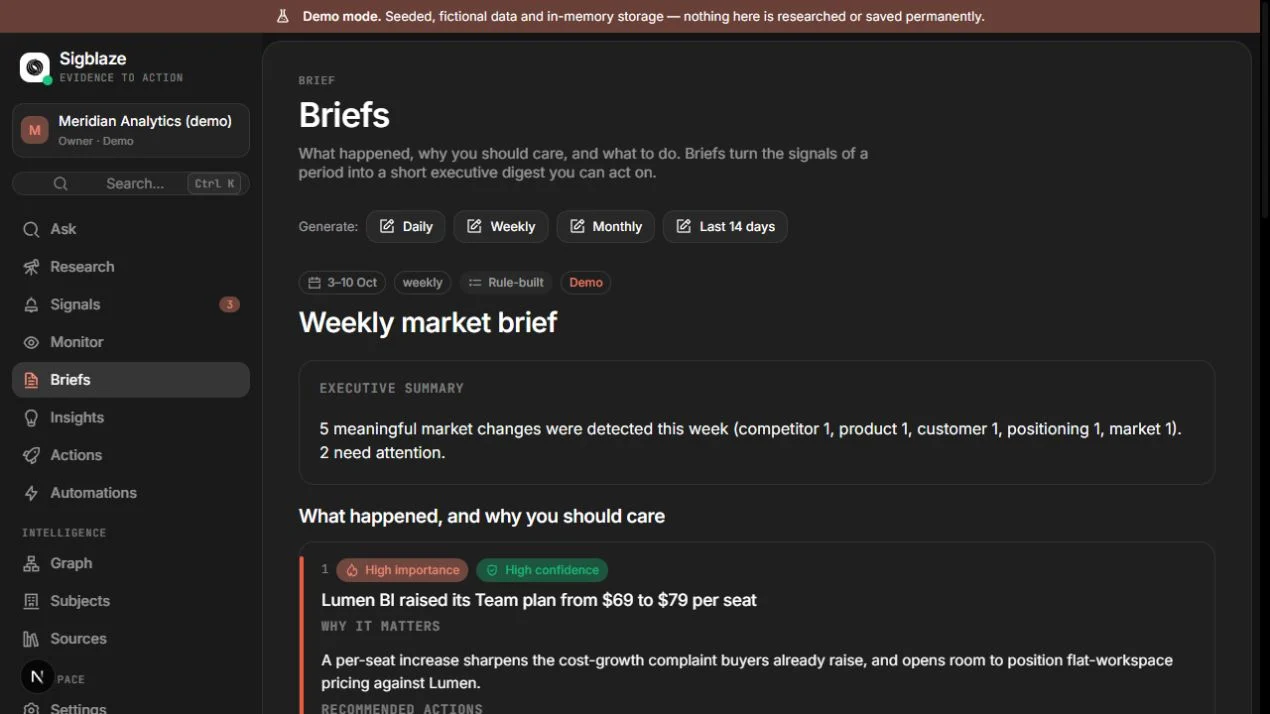
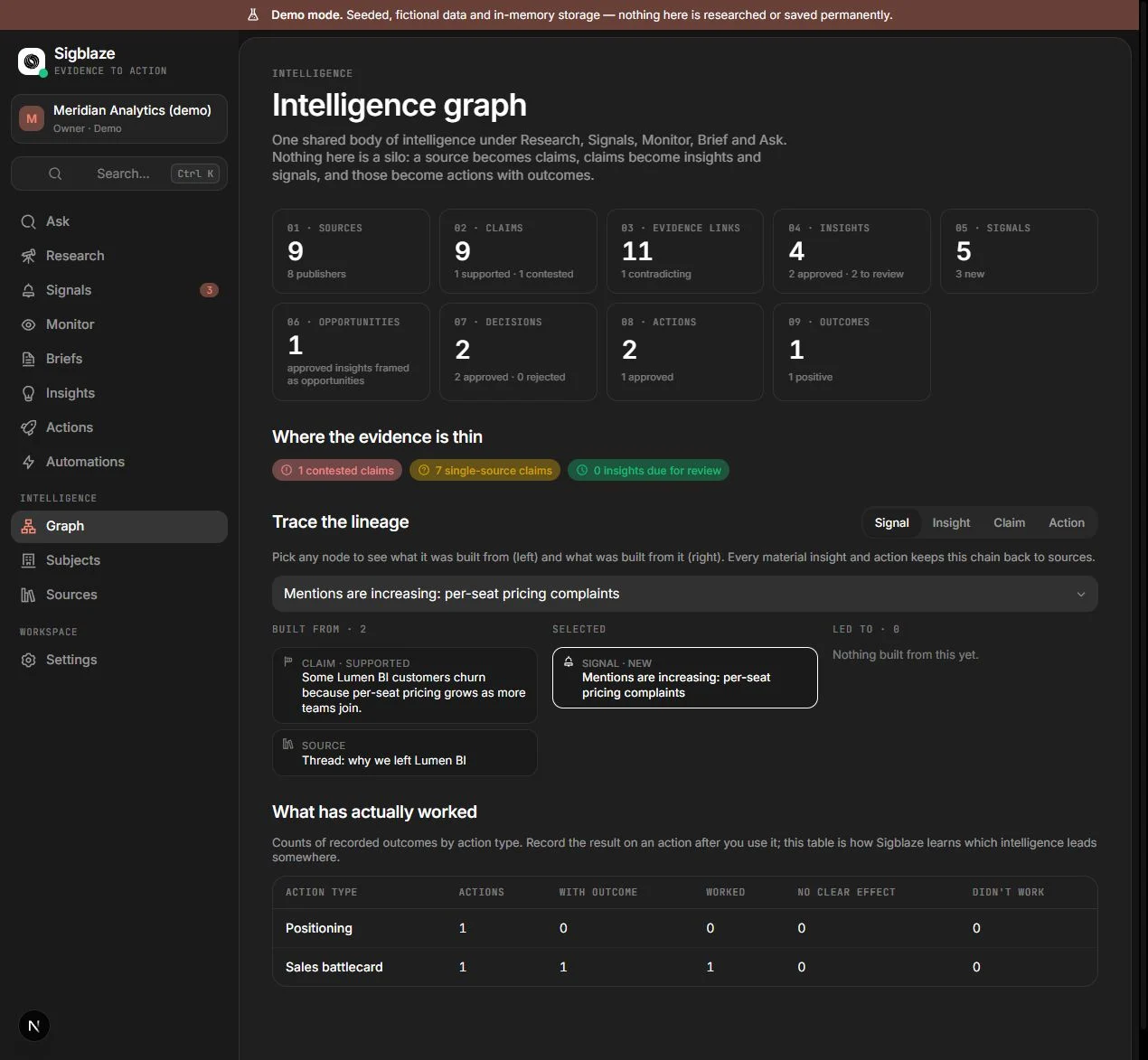
Design language
Quiet surfaces. Explicit states.
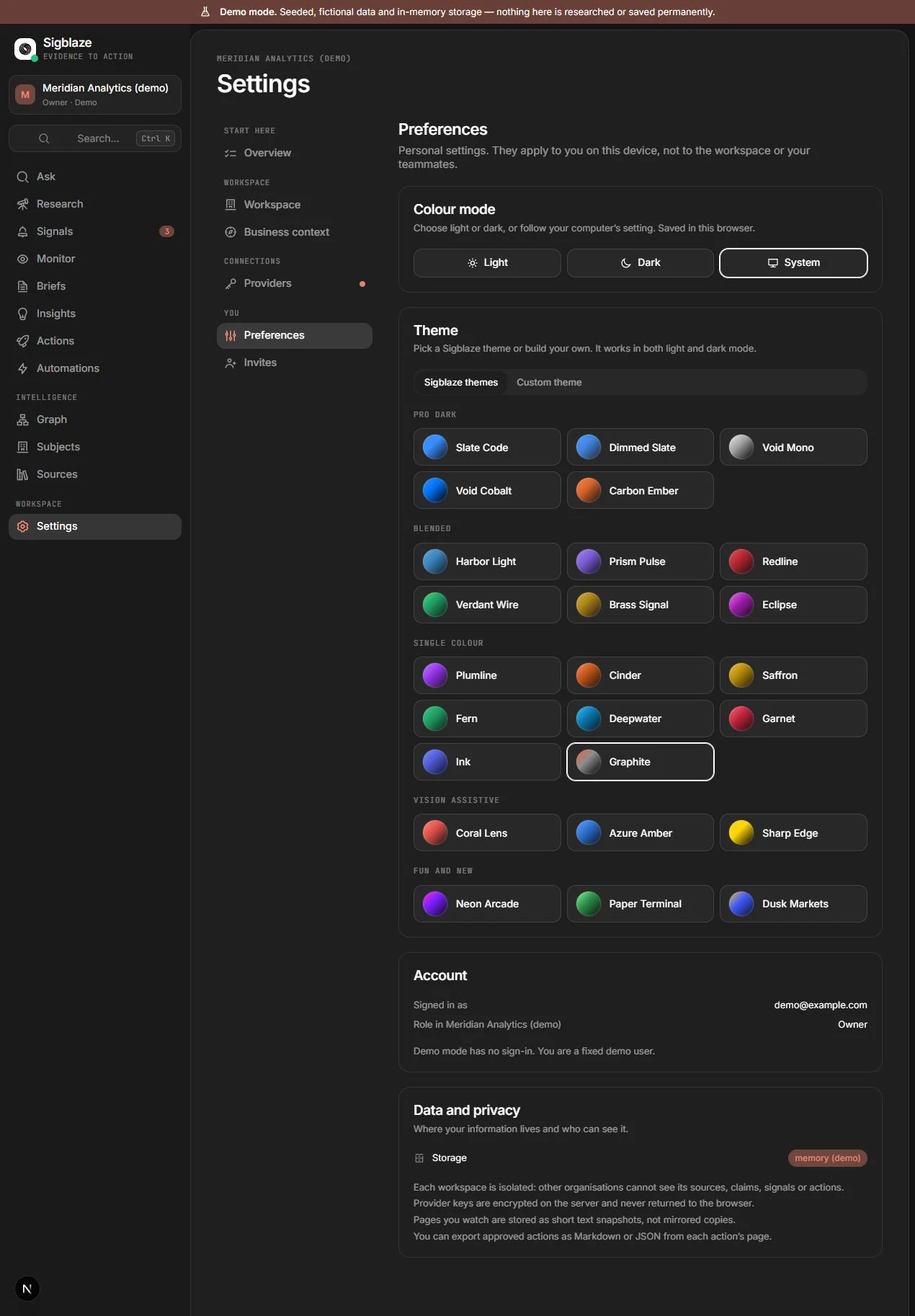
The app uses Nivoraq-derived tokens, Inter for the interface and JetBrains Mono for utility data. Monochrome panels and an orange accent keep attention on the research. Labels distinguish support, confidence, importance and review status; colour is reinforced with text and icons.
Preferences include light, dark and system modes, preset palettes and a custom-theme system with contrast-aware derivation. That implementation is distinct from this portfolio’s appearance controls, which remain intact.
Tradeoffs and limitations
Current limitations
Live research is disabled in the observed setup until retrieval and model providers are configured. Seeded data makes the interface reviewable, but cannot validate live extraction quality, citation correctness, cost or latency. Scripted demo monitoring demonstrates transitions rather than continuous observation of real companies.
One concrete gap appears in the captured battlecard: it links an approved insight but displays zero direct sources. The service includes lineage persistence and the linked insight has evidence, but the rendered seed does not complete the promised chain in that view. That mismatch should be resolved and tested before presenting the workflow as fully validated.
Reviewers need to verify source-backed claims. I would test whether users understand the confidence and freshness labels. The source includes authentication, role checks, and RLS migrations. I have not verified deployed tenant isolation through the local memory demo or injected-fake tests.
The early documents and current interface differ in scope. That is a documentation-maintenance problem to revisit: feature status should have one current source. Increasing the number of surfaces also risks burying the primary research-to-review path. A target-user study should test navigation before the product expands further.
| Area | What exists | Boundary |
|---|---|---|
| Research, sources and claims | Implemented · demo observed | Live retrieval and synthesis need configured providers. |
| Insight review and action lineage | Implemented · demo observed | Reviewed inputs are required; no autonomous campaign publishing. |
| Signals, Monitor and Briefs | Implemented · demo observed | Demo checks are scripted; real scheduling needs a cron trigger. |
| Ask, Graph and Automations | Implemented surfaces | Provider-backed answers and automated executions were not run live here. |
| Authentication and tenant storage | Real-mode code and migrations | The observed memory demo does not verify deployed RLS. |
| Alerts, uploaded-document retrieval, rich exports | Future direction | Do not treat roadmap entries as shipped functionality. |
What the evidence establishes
Implementation and test results
The tangible outcome is a working local workspace where a reviewer can move between a research run, its claims and sources, a signal’s before/after evidence, an insight and an action. A marketing website communicates the same product definition. This is implementation evidence, not a business-impact claim.
For this case-study review, 106 existing software tests passed across five selected suites covering domain rules, the research pipeline, monitoring, workflows and configurable providers. Captured screens establish demo rendering and navigation. No usability participants, customer adoption, award, launch outcome or measured commercial improvement is claimed.
Product storytelling
The website explains the same evidence model.
The local product website positions SigBlaze as private alpha and presents research, monitoring, signals, briefs and Ask as connected surfaces. Its interface imagery is labelled synthetic. That public positioning is not proof of a production launch or active users.

The next iteration
Next validation steps
I would ask target users to trace an action to its source, interpret a contested claim, and recover from missing evidence. I would observe where they get stuck and whether they can explain the source support.
Next, evaluate a bounded set of live research questions for citation validity, exact source spans, unsupported-answer refusal, outdated evidence, contradictions, cost and latency. Then test real-store tenant isolation and scheduled checks in a dedicated deployment. These are proposed validation steps.
Only after those results should the roadmap expand to uploaded documents, alerts, richer exports or white-labelled reports. The code’s workflow builder offers another path to reuse, but more automation should preserve review gates and evidence lineage.
Design reflection
What I would revisit
I would focus the next design review on source retention, uncertainty labels, approval permissions, and recovery after failed research. A reviewer needs to inspect and challenge an answer before using it.
I would revisit the breadth of navigation and the distinction between confidence, importance and factual support. I would also seek stronger evidence for the audience assumptions before extending the creative workflow. This reflection explains the current product through a design lens; exact individual build ownership and collaborator attribution still require confirmation.
Ask Modok
Questions about SigBlaze?
Ask about the work described here. Answers draw from this public page.